Speeding fines Qld drivers face start at $345 and 1 demerit point for driving less than 11 km/h over the limit, rising to $1,986 and 8 demerit points for more than 40 km/h over the limit. Queensland also applies a 6 month licence suspension for a more than 40 km/h offence after conviction, and repeat higher-range speeding can attract double demerit points.
This guide presents general information. Check current official road rules and follow every posted sign.
Speeding fines Qld: current amounts and points
Queensland speeding fines are set by offence bands, based on how far above the posted limit the vehicle was detected travelling. The figures below are the Queensland Government infringement amounts and demerit points current after the 1 July 2026 annual indexation increase. They apply to the common offence of driving over the speed limit under the Queensland Road Rules.
For a driver, the current speeding fine schedule is: less than 11 km/h over the limit, $345 and 1 point; at least 11 km/h but not more than 20 km/h over, $518 and 3 points; more than 20 km/h but not more than 30 km/h over, $777 and 4 points; more than 30 km/h but not more than 40 km/h over, $1,295 and 6 points; and more than 40 km/h over, $1,986 and 8 points.
These speeding fines in Queensland can be issued after a camera detection or by police roadside enforcement. A court can also deal with some matters, and court-imposed penalties can differ from the standard infringement amount. For example, unsafe speed near a children’s crossing or pedestrian crossing is listed as a court-imposed fine with 3 demerit points.
- Less than 11 km/h over: $345, 1 point
- 11-20 km/h over: $518, 3 points
- 21-30 km/h over: $777, 4 points
- 31-40 km/h over: $1,295, 6 points
- More than 40 km/h over: $1,986, 8 points
Demerit points for speeding in Queensland
Demerit points speeding Queensland drivers receive are added to the driver’s traffic history. Queensland does not start drivers with a balance of points to lose. Instead, you start from zero and points are added when an eligible offence is recorded.
For most drivers, points apply from the date of the offence, but they are recorded when the fine is paid, referred to the State Penalties Enforcement Registry for non-payment, dealt with by a court, or recorded from an interstate offence. This means the date you were detected is still important, especially when working out whether a licence sanction period or repeat-offence rule applies.
Licence type matters. Learner and provisional drivers can receive a sanction notice if they reach 4 or more demerit points within any 1 year period. Open licence holders can receive a sanction notice at 12 or more demerit points within any 3 year period. Interstate and overseas licence holders can also have their authority to drive in Queensland withdrawn if too many points are recorded.
- Learner licence: sanction at 4 or more points in 1 year
- Provisional licence: sanction at 4 or more points in 1 year
- Open licence: sanction at 12 or more points in 3 years
- Points do not reset just because you move to another licence type
Double demerits and high-speed offences
Queensland’s double demerit system is different from the holiday-period model used in some other states. In Queensland, double demerit points apply all year round for certain repeat offences within 1 year. For speeding, the repeat rule is aimed at higher-range speeding, not every minor speeding offence.
If you commit a second or further offence for driving more than 20 km/h over the speed limit within 1 year of a previous relevant speeding offence, double demerit points can apply to the later offence. In practical terms, a second 21-30 km/h offence within the 1 year period can be especially serious because the ordinary 4 points may become 8 points.
Driving more than 40 km/h over the limit has an extra consequence. If convicted, the driver is sent a Notice of Driver Licence Suspension for Speeding Offence. A Queensland licence is suspended for 6 months from the date stated in the notice, and a non-Queensland driver’s authority to drive in Queensland is also suspended for 6 months. The 8 demerit points still go on the traffic history, so the offence can also matter under the general demerit point scheme.
- No special Queensland holiday-only double demerit period for speeding
- Repeat higher-range speeding can double the points
- More than 40 km/h over can mean a 6 month suspension
- The suspension applies after conviction, including when the fine is paid
Speed cameras Qld drivers should understand
Speed cameras Qld drivers encounter include fixed speed cameras, mobile speed cameras, point-to-point cameras, combined red light and speed cameras, and red light cameras. Queensland’s camera program is run as a road safety enforcement program, with sites selected using crash history, crash severity, crash causes and high-risk speeding behaviour.
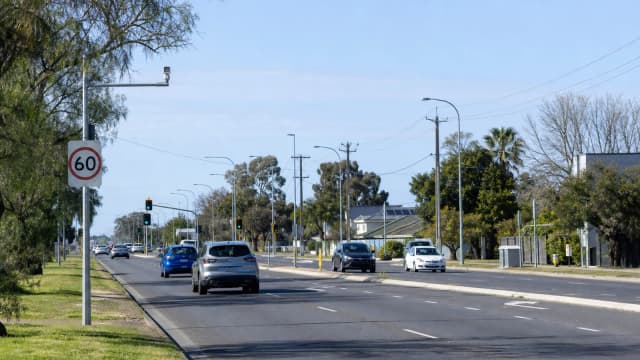
Fixed speed cameras are permanently installed on roads or at intersections. Queensland says fixed camera sites have signs placed before the camera as a courtesy reminder, but there is no legislative requirement for those signs to be installed. Point-to-point cameras measure travel over a length of road, commonly on high-volume roads such as highways and motorways.
Mobile speed cameras can operate at approved sites at any time of day or night and on any day of the year. Queensland lists up to 3,000 mobile speed camera sites, and deployments are random to make enforcement less predictable. Camera vehicles can be marked or unmarked. Police can also use hand-held speed cameras at approved sites. A navigation or alert app, such as Speed Camera Radar Detector, should only be set up before driving and treated as a reminder tool, not a guarantee of coverage.
- Fixed speed cameras
- Mobile speed cameras
- Point-to-point speed cameras
- Combined red light and speed cameras
- Police hand-held speed cameras
What happens after a camera-detected speeding fine
A camera-detected speeding ticket is usually sent to the registered owner of the vehicle using the registration details. The notice includes the image or images of the offence, the date and time, the location, the speed limit at the location, the alleged detected speed, the fine amount and the demerit points allocated.
If you receive a camera-detected ticket in Queensland, the usual options are to pay the fine, transfer responsibility to the driver or responsible person if you were not driving, or elect to have the matter dealt with by a court. Queensland Police state that the notice must be dealt with within 28 days, and you should not pay it if you were not in charge of the vehicle or if you intend to have the matter heard in court.
Queensland Police also state there are no provisions for leniency just because a driver has a good driving record, an interstate gold licence or no previous ticket. If a fine is not dealt with by the due date, it may be referred to the State Penalties Enforcement Registry for enforcement action.
- Pay the fine
- Nominate the responsible driver
- Elect court if you dispute the matter
- Act within 28 days of the notice
Practical ways to avoid a Queensland speeding fine
The simplest way to avoid speeding fines in Queensland is to drive to the posted limit and adjust early when the limit changes. Queensland roads can shift quickly between motorway limits, suburban arterials, roadworks, school zones and local streets. The limit shown on the sign is the legal reference point, not the speed that surrounding traffic appears to be doing.
Allow extra time on long trips, especially on routes such as the Bruce Highway, Warrego Highway, Pacific Motorway and regional roads where conditions can change quickly. Cruise control can help on open roads, but the driver remains responsible for watching speed signs, roadworks signs, downhill speed creep and changing traffic conditions.
This article is general road safety information, not legal advice. If you receive a fine, read the notice carefully because it will state the alleged offence, amount, points and response options. For a serious allegation, a court election, or a licence suspension risk, consider getting advice from a qualified professional before choosing how to respond.
- Check your speed after every speed-limit change
- Slow early for roadworks and school zones
- Leave a time buffer for trips
- Do not assume another driver’s speed is safe or legal
- Read any infringement notice before paying or nominating
A simple pre-drive checklist
- Set the route and alerts before moving.
- Check the first posted limit after every major turn.
- Leave enough space to adjust without abrupt braking.
- Use official sources when a rule affects your licence.