Speeding fines Victoria drivers receive depend on how far over the limit they are detected, the type of vehicle, and whether an automatic licence suspension applies. As at 1 July 2026, a full licence holder in a car faces a $261 fine and 1 demerit point for less than 10 km/h over the limit, rising to $1,046 and a 12 month suspension for 45 km/h or more over the limit.
This guide presents general information. Check current official road rules and follow every posted sign.
Speeding fines Victoria: current amounts for cars
For most car drivers and motorcycle riders, the current speeding fine in Victoria starts at $261 for travelling less than 10 km/h over the posted speed limit. The next common band is 10 km/h to 24 km/h over the limit, which is a $418 fine. These amounts are the Fines Victoria infringement amounts for full licence holders and are adjusted each July, so an older notice or article may show a different figure.
The higher speeding bands are treated much more seriously. From 25 km/h over the limit, Fines Victoria lists an automatic licence suspension rather than ordinary demerit points. The current amounts are $575 for 25 km/h to 29 km/h over, $680 for 30 km/h to 34 km/h over, $784 for 35 km/h to 39 km/h over, $889 for 40 km/h to 44 km/h over, and $1,046 for 45 km/h or more over.
There is also a special entry for 20 km/h to 24 km/h over the limit in a 110 km/h zone. Although it sits inside the 10 km/h to 24 km/h speeding range, the Fines Victoria table lists a $418 fine and an automatic 3 month suspension for that category.
- Less than 10 km/h over: $261 and 1 demerit point
- 10 km/h to 24 km/h over: $418 and 3 demerit points
- 25 km/h to 34 km/h over: 3 month automatic suspension
- 35 km/h to 44 km/h over: 6 month automatic suspension
- 45 km/h or more over: 12 month automatic suspension
Demerit points for speeding in Vic
Demerit points speeding Vic penalties are simple at the lower bands: less than 10 km/h over the limit carries 1 point, while 10 km/h to 24 km/h over the limit carries 3 points. Once the offence reaches the suspension bands, the published speeding table focuses on the automatic suspension period rather than listing ordinary demerit points.
Transport Victoria says all drivers start with zero demerit points. Learner and probationary drivers have a lower threshold: 5 points in any 12 month period, or 12 points in any 3 year period. Full licence holders and most other adult licence holders have a 12 point limit in any 3 year period.
Demerit points can matter even when the fine amount looks manageable. If you reach or exceed your limit, VicRoads will notify you and you may have to choose between serving a suspension or extending the demerit point period. If you believe a fine was issued to the wrong person, deal with that through the fine process early, because VicRoads records points issued by agencies such as Fines Victoria and the courts.
- Learner and P plate drivers: 5 points in 12 months, or 12 points in 3 years
- Full licence drivers: 12 points in 3 years
- Lower speeding bands: 1 or 3 demerit points
- Higher speeding bands: automatic suspension periods
Heavy vehicle speeding fines
Heavy vehicle speeding fines are higher than standard car penalties. Heavy vehicle penalties apply to vehicles with a gross vehicle mass over 4.5 tonnes, combinations with a gross combination mass over 14.5 tonnes, and buses with more than 12 seats.
For full licence holders in heavy vehicles, the current penalty is $366 and 1 point for less than 10 km/h over the limit. The 10 km/h to 14 km/h band is $575 and 3 points, while 15 km/h to 24 km/h is $836 and 3 points. From 25 km/h over the limit, the table lists automatic suspension periods: $1,150 and 3 months for 25 km/h to 29 km/h over, $1,464 and 3 months for 30 km/h to 34 km/h over, $1,777 and 6 months for 35 km/h to 39 km/h over, $2,091 and 6 months for 40 km/h to 44 km/h over, and $2,405 and 12 months for 45 km/h or more over.
If you drive for work, a speeding fine can also affect employment, accreditation, insurance and fatigue or safety management systems. Operators and drivers should treat heavy vehicle speeding as a compliance issue, not just a personal fine.
How speed cameras Victoria enforcement works
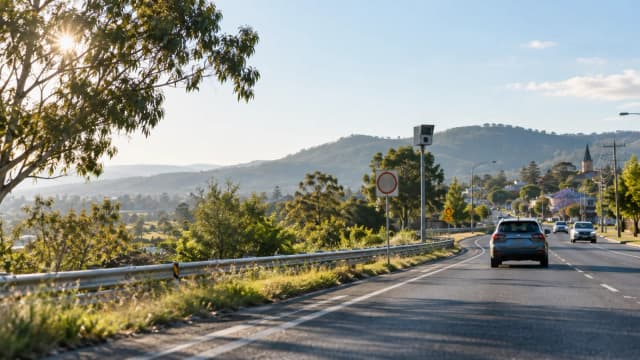
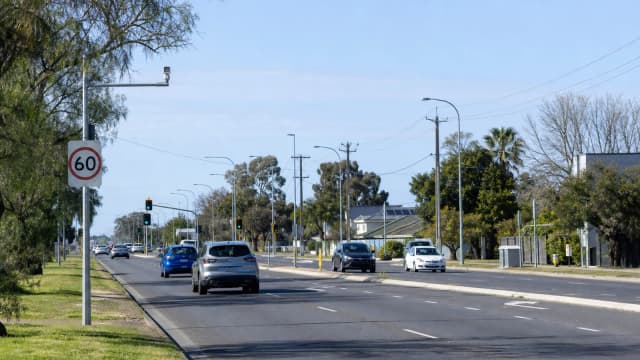
Speed cameras Victoria wide include fixed speed cameras, mobile digital road safety cameras, red light cameras that may also detect speed, and point-to-point average speed cameras on selected high-speed roads. The Victorian Government describes these as road safety cameras, and Victoria Police reviews potential offences before a fine is issued.
Fixed digital cameras are installed at intersections, freeways, railway level crossings and highways. On major roads they can include instantaneous speed cameras, which detect speed at one location, and point-to-point systems, which calculate average speed between two camera locations. Victoria lists fixed cameras on routes including CityLink, EastLink, the Hume Freeway, Peninsula Link, the Western Ring Road, the Monash Freeway and other major corridors.
Mobile digital road safety cameras can be used across the state to enforce speed limits. Approved mobile camera locations are published by the Victorian Government, but drivers should not rely on a list as a reason to speed elsewhere. A mobile camera detection records information such as the vehicle image, date, time, location and detected speed, then the matter is checked before enforcement action is taken.
Point-to-point average speed cameras work differently from a single flash at one spot. They use an entry and exit location, match the vehicle across the camera locations, and calculate whether the vehicle travelled the distance faster than it could have at the legal speed limit. These systems may also check the vehicle’s speed at each individual camera location.
What happens after an infringement notice
A speeding infringement notice tells you the offence, the amount owed, how to pay, your options and the due date. Victoria Police says infringement notices can be issued by an officer or by road safety cameras. From February 2025, some on-the-spot notices can also be issued electronically, but suspicious messages should be treated carefully and checked through Fines Victoria or Victoria Police channels.
If you were not driving, nomination should be handled promptly through the fine process. For camera offences involving a company vehicle, the organisation is generally expected to nominate the responsible driver. If a company fails to nominate, the company penalty can be much higher than the driver’s fine.
If you do nothing, extra fees and enforcement steps can follow, including a Notice of Final Demand, enforcement action, and possible driver or vehicle sanctions. If you cannot pay by the due date, Victoria Police says payment extensions and instalment options may be available through Fines Victoria, subject to eligibility.
- Pay by the due date
- Nominate the responsible driver if required
- Request a review if you have a valid reason
- Elect to go to court if you want a magistrate to decide
- Apply for an extension or instalments if eligible
Reviews, official warnings and safer planning
Victoria Police may withdraw an infringement and issue an official warning in some cases, but it is not automatic. Factors can include the time of the offence, weather, traffic density, road conditions and whether the detected speed was less than 10 km/h over the posted limit. You must request a review through Fines Victoria to be considered.
If you think a notice is wrong, act early and keep evidence organised. Possible issues might include the wrong driver, a sold vehicle, stolen plates, or a genuine reason to request review. This is general information only, not legal advice. For serious offences, automatic suspension, court election, or complicated circumstances, get independent legal advice before deciding what to do.
The safest way to avoid speeding fines Vic drivers receive is to treat the posted limit as the maximum, including temporary roadwork signs, school zones, variable limits and the 40 km/h rule around eligible emergency, enforcement and roadside assistance scenes. If you use the Speed Camera Radar Detector app, set it up before you drive as a planning aid only, and never handle a phone while driving.
A simple pre-drive checklist
- Set the route and alerts before moving.
- Check the first posted limit after every major turn.
- Leave enough space to adjust without abrupt braking.
- Use official sources when a rule affects your licence.