For most drivers asking about a red light camera fine in the UK, the practical answer is simple: in Great Britain the usual fixed penalty is £100 and 3 penalty points, while Northern Ireland currently uses a £60 conditional offer and 3 penalty points for red light running detected by camera. More serious cases, ignored notices or disputed allegations can go to court, where the financial penalty can be higher.
This guide presents general information. Check current official road rules and follow every posted sign.
What a red light camera fine in the UK means
A red light camera is used to record a vehicle that crosses the stop line after the signal has changed to red. The offence is not about whether the junction looked clear, or whether the driver intended to go through. The key issue is whether the vehicle passed the stop line when the red signal applied.
In England, Wales and Scotland, the normal camera outcome is a Notice of Intended Prosecution and a requirement to identify the driver, followed by a conditional offer of fixed penalty if the case is suitable. That fixed penalty is normally £100 and 3 penalty points. In Northern Ireland, PSNI information states that a red light running offence dealt with by conditional offer is £60 and 3 penalty points.
If the matter is dealt with at court in Great Britain, The Highway Code penalties table gives traffic light offences a maximum fine of £1,000, 3 penalty points and possible discretionary disqualification. In Northern Ireland, nidirect lists the same £1,000 court maximum, discretionary disqualification and 3 penalty points for traffic light offences.
- Great Britain: usually £100 and 3 points
- Northern Ireland: currently £60 and 3 points by conditional offer
- Court maximum: £1,000 for a traffic light offence
- Possible court disqualification in serious cases
What the Highway Code says at traffic lights
The Highway Code is direct: red means stop and drivers must wait behind the stop line. Red and amber also means stop, so you must not pass through or start moving until green shows. Green does not mean proceed regardless, because you may go only if the way is clear.
Amber is often misunderstood. The rule is that amber means stop at the stop line. You may continue only if the amber appears after you have crossed the stop line, or if you are so close that stopping might cause an accident. Treating amber as an invitation to accelerate is risky, especially near a junction with a red light camera.
Green filter arrows also matter. If a green arrow is shown, you may proceed only in the direction indicated by that arrow, and only if the way is clear. Moving straight ahead from a turn-only lane or ignoring a lane signal may be treated differently depending on the signal and road markings, but the basic rule remains that light signals and stop lines must be obeyed.
How the notice process usually works
When a camera records an alleged offence, the registered keeper is normally sent a Notice of Intended Prosecution and a request for driver details. The first notice is generally expected within 14 days for camera-detected offences, although there can be exceptions, for example if the registered keeper details are not up to date or the vehicle is leased, hired or recently sold.
The keeper must respond to the driver information request within the stated time, commonly 28 days. This is separate from whether the keeper agrees with the allegation. Failing to identify the driver can itself lead to a separate offence with a heavier penalty, so the notice should not be ignored.
Once the driver has been named, the police or safety camera unit decide the next step. That may be a course offer where one is available and suitable, a fixed penalty, a conditional offer, or court proceedings. There is no automatic right to a driver retraining course, and the police decide whether to offer one.
- Read the notice carefully
- Reply within the stated deadline
- Keep copies of any response
- Do not ignore a driver details request
Penalty points, new drivers and insurance
The endorsement code for failing to comply with traffic light signals in Great Britain is TS10, and the Driver and Vehicle Licensing Agency lists it as 3 penalty points. Traffic direction and sign endorsements of this type normally stay on the driving record for 4 years from the date of the offence.
Penalty points can have wider effects than the fine itself. The Driver and Vehicle Licensing Agency states that a driver can be disqualified if they build up 12 or more penalty points within 3 years. New drivers also need to be especially careful: if a driver reaches 6 or more points within 2 years of passing the first practical test, their licence can be revoked under the new driver rules.
Insurance is not part of the camera penalty, but insurers may ask about motoring convictions or endorsements. Answer insurance questions accurately and check the policy wording, because disclosure periods and insurer questions are not always the same as DVLA record periods.
- TS10: failing to comply with traffic light signals
- 3 penalty points
- Endorsement normally remains for 4 years
- New drivers face a 6-point revocation threshold
When a red light case may go to court
A straightforward red light camera allegation is often dealt with by fixed penalty or conditional offer. Court becomes more likely if the driver does not accept the offer, does not respond properly, already has too many points, the allegation is linked with another offence, or the circumstances are considered too serious for the fixed penalty process.
At court, the fine is not simply the fixed penalty amount. The court can consider the facts, any guilty plea, financial circumstances and whether disqualification is appropriate. The published maximum for a traffic light offence is £1,000, but the actual outcome depends on the case.
If you believe the allegation is wrong, for example the vehicle was not yours or the signal evidence is disputed, follow the instructions on the paperwork. This page is general road-safety information, not legal advice. If court proceedings are possible and you are unsure, consider independent advice before making decisions.
Practical safety lessons at red light cameras
The safest way to avoid a red light offence is to plan to stop, not to gamble on getting through. Ease off as you approach controlled junctions, especially where visibility is poor, the road is wet, traffic is close behind or pedestrians may be crossing. A smooth stop on amber is usually safer than a late decision at the line.
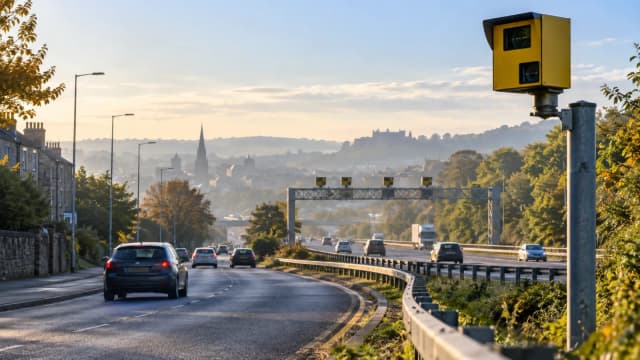
Do not rely on seeing a camera box. Not every junction has a red light camera, and not every camera-looking device is an enforcement camera. Police can also deal with red light offences without a fixed camera, for example after a roadside stop or from other evidence. The legal duty is to obey the signal, whether or not a camera is present.
Camera-alert tools can be useful for journey planning, but they do not change the law or guarantee coverage. If you use the Speed Camera Radar Detector app, set any route or alerts before driving and never handle your phone at the wheel.
- Slow early on approach
- Expect amber to mean stop
- Leave space from the vehicle ahead
- Watch for pedestrians and cyclists
- Set navigation before moving
A simple pre-drive checklist
- Set the route and alerts before moving.
- Check the first posted limit after every major turn.
- Leave enough space to adjust without abrupt braking.
- Use official sources when a rule affects your licence.