
Los Angeles, United States
Speed Cameras in Los Angeles
For speed cameras Los Angeles drivers should know that LADOT starts activating the first AB 645 cameras on October 26, 2026, with a 60-day warning period. The city plans 125 fixed sites by the end of 2026.
Speed camera locations in Los Angeles
Use camera information alongside posted signs, junctions, roadworks and changing conditions.
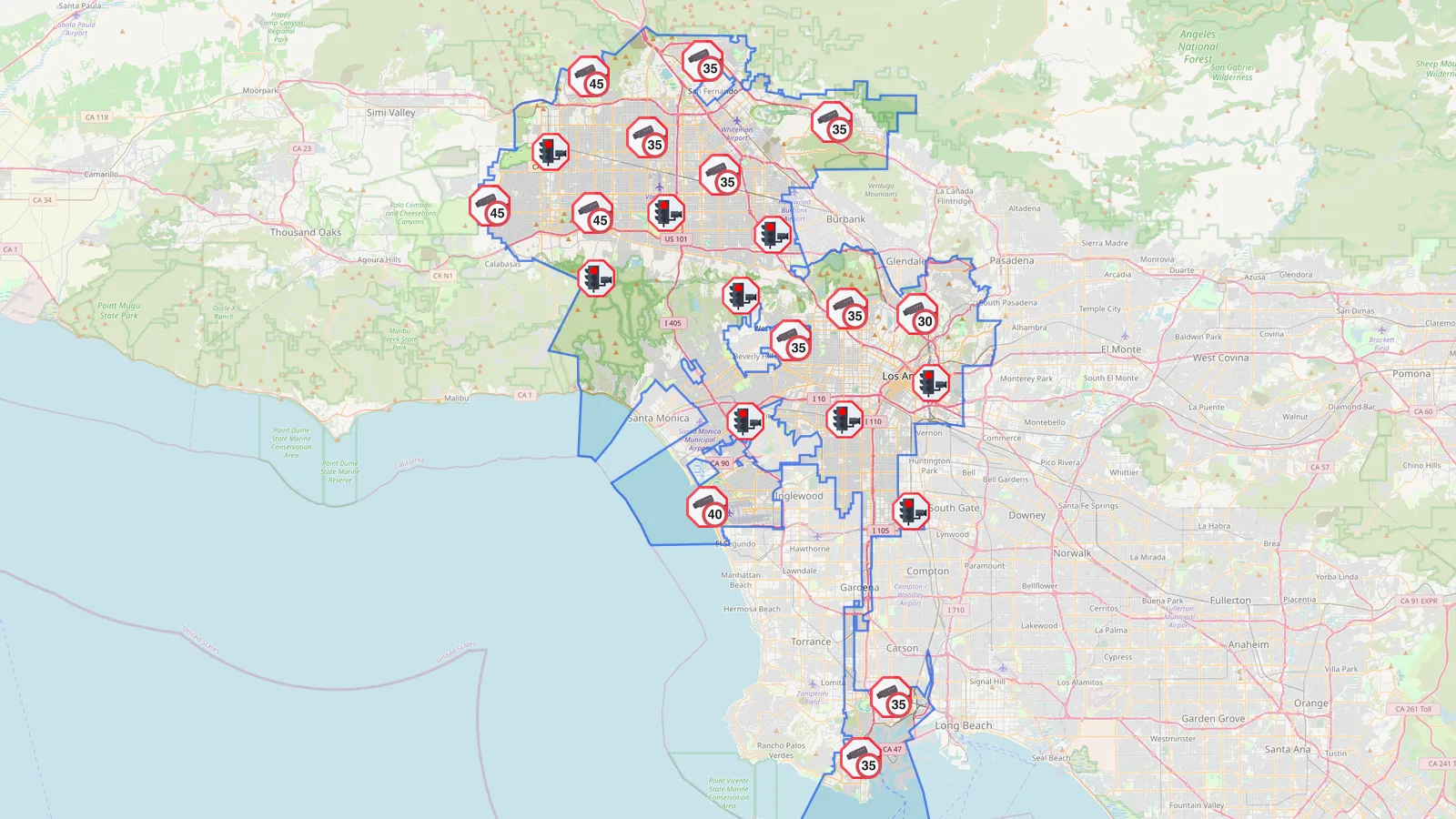
 Speed or average speed
 Red light
 Speed and red light
Cameras in Los Angeles
Approximate totals from the app's camera database, across the whole city.
Common speed-camera locations
Where enforcement is concentrated. Camera sites change, so posted signs always come first.
All 15 council districtsEight or nine LADOT speed camera sites per district
High-injury corridorsStreets chosen for speeding and severe-crash history
School and senior areasSites near vulnerable people are prioritized
Street-racing corridorsEligible corridors with racing or takeover history
Speed cameras Los Angeles: what is operating
Los Angeles is launching a fixed speed safety camera pilot under California AB 645. LADOT says the first systems will activate on October 26, 2026, and that all 125 planned sites are expected to be active by the end of 2026. The first 60 days of operation are warnings rather than fines, and the same warning period applies when additional cameras are activated on new streets.
The Los Angeles speed cameras are designed to record vehicles traveling at least 11 mph over the posted limit. They photograph the rear license plate, not the driver’s face, and LADOT administers the program as a civil traffic safety program. Revenue is restricted to traffic safety purposes, such as street safety programs and improvements.
There is no citywide average speed camera program in Los Angeles. The current city program is fixed point speed enforcement. California also authorizes a separate Caltrans work-zone speed safety pilot on state highway work zones, but that is not the same as LADOT’s city street program and applies only when the state program is active and signed.
Los Angeles speed camera locations and hours
LADOT selected Los Angeles speed camera locations using crash, speed and equity data, then spread them across every council district. The city’s public materials describe the strongest focus as streets where speeding and crashes happen most often, plus areas near children, seniors and other vulnerable street users. School zones, high-injury streets and places with a history of speed racing are the main program categories.
Drivers should expect the sites to be on surface streets rather than freeways or unincorporated county roads. State law does not allow AB 645 city speed cameras on California state routes, freeways, expressways, United States highways or county roads under CHP primary jurisdiction. LADOT must publish approved street sections and the hours of enforcement, and photo enforcement warning signs with the posted speed limit must be placed before cameras.
Operating hours can vary by site and should be checked against posted signs and LADOT’s published materials before a trip. Do not use a phone while driving to check camera information. If you use the Speed Camera Radar Detector app, set up alerts before you drive and treat them as planning aids, not a guarantee of complete coverage.
- 125 planned city sites
- Fixed, signed camera points
- City streets, not freeways
- Warnings before fines
Red lights, school zones and work zones
For red light cameras Los Angeles drivers should separate the old city red-light program from the new speed camera pilot. Current City of Los Angeles materials reviewed for this guide describe a speed safety system program, not an active citywide red light camera program. Red light running can still be enforced by officers, and automated red light rules may differ in nearby cities inside Los Angeles County.
School zones matter in two ways. First, AB 645 specifically allows Los Angeles speed cameras in school zones and other safety-priority areas. Second, California’s usual school-zone rule is separate from camera enforcement: the prima facie limit is 25 mph when approaching or passing a signed school area while children are going to or leaving school, during school hours or during noon recess, unless a different posted rule applies.
Work zones are also separate. LADOT’s AB 645 program is not an average speed or work-zone-only system. Caltrans has separate authority for state highway work-zone speed safety systems, which can issue citations only when workers are present in the state highway work zone. On city streets, follow the posted temporary work-zone signs and any direction from workers or officers.
Tickets, fines and contesting a notice
Speed camera notices are mailed to the registered vehicle owner. California law requires a written notice of violation to be issued within 15 calendar days of the violation date. The notice must identify details such as the alleged speed, speed limit, location, date and time, and it must include instructions for contesting the notice.
A camera speeding violation under AB 645 is a civil penalty, not a moving violation. It does not add a DMV violation point and does not by itself suspend or revoke a driver’s license. The fine schedule is $50 for 11-15 mph over after the first-warning rule, $100 for 16-25 mph over, $200 for 26 mph or more over, and $500 for a vehicle recorded at 100 mph or more.
To contest, the recipient may request an initial review within 30 calendar days from the notice mailing date. If the review is denied, the recipient may request an administrative hearing within 21 calendar days after the review result is mailed. The hearing can be by written declaration, video conference or in person, and the notice should explain payment, waiver and appeal procedures.
Local speed limits to expect
Most everyday driving in Los Angeles is governed by the posted limit and California’s basic speed law, which requires a speed that is reasonable for conditions. In business and residential districts, the default prima facie limit is 25 mph unless another speed is posted. Alleys and some special situations can be lower.
Many major Los Angeles surface streets are posted around 30-35 mph, while freeway limits are commonly 55-65 mph where posted. LADOT has also been reducing some corridor speeds under California’s newer speed-setting authority, so the sign on the block controls. Camera penalties are based on the posted limit at the camera location, with enforcement beginning at 11 mph over.
Camera types in Los Angeles
01
Always in place
Fixed cameras
Permanent cameras at fixed locations
02
Flexible location
Mobile cameras
Moved regularly to different locations
03
Junction safety
Red light cameras
Detect red-light violations at junctions
04
Zone monitoring
Average speed cameras
Measure average speed over a distance
Speeding fines
| Level | Typical outcome | Licence impact |
|---|---|---|
| 11-15 mph over | First such violation is a warning, then $50 | Civil notice, no DMV point |
| 16-25 mph over | $100 civil penalty to the registered owner | No license suspension or point |
| 26+ mph over, or 100+ mph | $200, or $500 at 100 mph or more | No DMV point from camera case |
Amounts and thresholds can change. Check current official guidance for the relevant state, city or court.
Frequently asked questions
Are speed cameras legal in Los Angeles now?
Yes. Los Angeles is one of the California cities authorized under AB 645 to run a five-year speed safety camera pilot. The first LADOT cameras are scheduled to activate on October 26, 2026, with warnings before fines.
Do Los Angeles speed camera tickets add points?
No. AB 645 speed camera penalties are civil notices to the registered owner. They do not add DMV points and do not suspend or revoke a license by themselves.
Where are Los Angeles speed cameras concentrated?
LADOT says the 125 sites are spread across all 15 council districts, with priority for high-speed, high-crash streets, school zones, senior areas and corridors with street-racing history.
Are there red light cameras in Los Angeles?
The current City of Los Angeles automated program reviewed here is for speed, not red lights. Red light violations can still be enforced by officers, and nearby cities may have different camera programs.
Can I contest a Los Angeles speed camera notice?
Yes. The notice should explain how to request a free initial review within 30 calendar days of mailing. If that is denied, an administrative hearing can be requested within 21 calendar days after the review result is mailed.
Learn more
Detector laws
Are Radar Detectors Legal in California?
California radar detector rules for private cars, commercial vehicles, windshield mounting, and illegal laser jammers.
Detector laws
Are Radar Detectors Legal? A State-by-State Guide
Clear 2026 guide to radar detector laws by state, including Virginia, D.C., commercial vehicles, military bases and app use.
Drive with more context
Download on theApp StoreKnow what is ahead before you reach it.
Explore camera locations, navigation and timely alerts in Speed Camera Radar Detector.