So, are radar detectors legal in New York? Yes, for most drivers in private passenger vehicles, radar detectors are legal in New York. The important exceptions are heavy vehicles and commercial vehicles, where New York law and federal motor carrier rules can prohibit use or possession.
This guide presents general information. Check current official road rules and follow every posted sign.
Are radar detectors legal in New York?
For ordinary private drivers, New York does not have a general statewide ban on radar detectors in passenger cars, SUVs, minivans or light personal pickups. That means a driver in a typical privately used vehicle can legally own and use a passive radar detector in New York, including on city streets, state highways and interstates, as long as another rule is not being violated.
New York law is more specific than many drivers expect. The state defines a radar detector as an instrument designed to detect microwaves on frequencies assigned for maintaining vehicle speed. The law that actually prohibits detectors is targeted at heavier vehicles and commercial vehicles, not at every driver on the road.
A radar detector also does not create any defense to a speeding ticket. If an officer measures speed, observes unsafe driving or issues a citation based on another enforceable rule, the fact that a detector was legal in the car does not cancel the underlying violation. Treat a detector as information only, never as permission to drive above the posted limit.
- Private cars, SUVs, minivans and light pickups
- Personal vehicles in New York City
- Rental cars driven for personal use
- Motorcycles, unless another rule applies
The commercial and heavy-vehicle exception
New York Vehicle and Traffic Law Section 397-a prohibits radar detectors and laser detectors in two main categories: any motor vehicle with a gross vehicle weight rating of more than 18,000 pounds, and any commercial vehicle with a gross vehicle weight rating of more than 10,000 pounds. GVWR is the manufacturer’s rated maximum loaded weight, not just the weight of the vehicle on a particular day.
That difference matters for box trucks, large pickups used commercially, delivery vans, buses, moving trucks and vehicles used by a business. A vehicle can fall into the restricted category even if it is empty, because the rule is based on rating and commercial status. Drivers should check the vehicle’s certification label, registration class and employer policies before assuming a detector is allowed.
New York also creates a presumption of use when a radar or laser detector is present in a restricted vehicle, connected to a power source and in operable condition. A violation is a traffic infraction punishable by a fine of $25-$100. The same state section says it does not by itself authorize seizure or forfeiture of the detector unless another law provides for that.
Federal motor carrier rules add another layer. Under 49 CFR 392.71, a driver may not use a radar detector in a commercial motor vehicle or operate a commercial motor vehicle that is equipped with or contains one. The regulation also says a motor carrier may not require or permit a driver to violate that rule. For CDL drivers and motor carriers, the safest practical reading is simple: do not bring a radar detector into a regulated commercial motor vehicle.
- More than 18,000 pounds GVWR, any motor vehicle
- More than 10,000 pounds GVWR, commercial vehicle
- Commercial motor vehicles covered by federal rules
- Employer or fleet policies that are stricter than state law
Mounting a detector without blocking your view
Even when a radar detector is legal in your vehicle, where you place it can create a separate problem. New York equipment law prohibits operating a motor vehicle with an object placed or hung in or on the vehicle in a way that obstructs or interferes with the driver’s view through the windshield, or prevents a clear and full view of the road and traffic conditions behind the vehicle.
The law does not name every possible accessory. Instead, it focuses on whether the object blocks or interferes with visibility. A large suction-cup mount in the center of the windshield, a cord hanging across the driver’s view or a device placed where it hides pedestrians, cyclists, signs or signals can draw attention even if the detector itself is allowed.
A practical approach is to keep the windshield and mirror area clear, secure any device so it cannot fall or slide, and make all settings before you drive. Do not handle a detector, app or phone while the vehicle is moving.
- Clear forward view
- Clear mirror view
- No loose cords in the sightline
- Settings handled before driving
Radar detectors, laser detectors and police scanners are different
New York’s detector law refers to both radar detectors and laser detectors. A radar detector listens for radar signals used in speed measurement. A laser detector is a device designed to detect laser speed detection devices. Many modern units combine both functions, so a single device may be treated as both for purposes of the heavy-vehicle and commercial-vehicle restrictions.
A passive detector is also different from a device that interferes with enforcement equipment. This article is about passive detection, not active jamming, blocking or transmitting devices. Do not assume those devices follow the same rules, and do not use equipment designed to interfere with police or traffic-safety technology.
Police scanners are a separate issue as well. New York has a different statute covering motor vehicles equipped with radio receiving sets capable of receiving police frequencies, with limited exceptions such as properly licensed amateur radio operation. A radar detector is not the same thing as a police scanner, but drivers should avoid combining the two topics or assuming that one rule answers both.
Speed cameras and photo enforcement in New York
A radar detector does not warn you about every kind of speed enforcement. Many camera programs work from fixed or mobile photo-enforcement systems, roadway sensors, time-distance calculations, radar or other technology that may not create a useful detector alert before the vehicle is recorded. A detector also does not identify every posted speed limit, school zone or work zone.
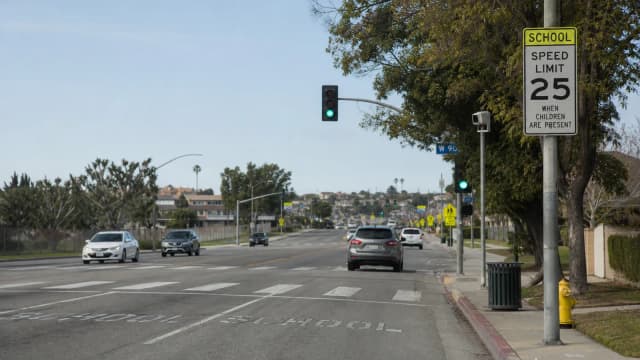
New York City operates speed cameras in 750 school speed zones, and the city issues school-zone speed camera violations 24 hours a day, seven days a week, year-round. NYC’s program is aimed at vehicles traveling more than 10 mph over the posted maximum speed limit in a school speed zone. These violations are issued to the vehicle owner, not handled like a roadside officer stop.
Outside New York City, New York State has also expanded automated work zone speed enforcement. The New York State Department of Transportation announced in 2026 that the Automated Work Zone Speed Enforcement program was expanded so it is no longer limited to controlled-access highways and may be deployed in work zones on roadways under NYSDOT jurisdiction. Work zones can change frequently, so posted signs and temporary speed limits matter.
If you want camera awareness, plan before the trip. The Speed Camera Radar Detector app can be used to set up camera and alert awareness before driving, but no app or detector can guarantee complete coverage or replace watching posted signs.
- NYC school speed zones
- State work zones
- Red light camera locations
- Bus lane camera corridors
Crossing state lines from New York
New York drivers often cross into New Jersey, Connecticut, Pennsylvania, Massachusetts or Vermont on the same day. Radar detector rules are not identical everywhere, and federal commercial motor vehicle rules can follow the vehicle and operation rather than the state border. If you drive for work, tow heavy equipment, operate a bus or use a vehicle near a weight threshold, check the applicable rules before the trip begins.
The bottom line is straightforward for most personal drivers: radar detectors are legal in New York private passenger vehicles, but illegal or restricted for many heavy and commercial vehicles. Keep any permitted device from blocking your view, set it before you move, and drive according to the posted speed limit and road conditions. For commercial drivers, fleet vehicles and heavy vehicles, the better assumption is that a radar detector does not belong in the cab unless a qualified compliance source confirms otherwise.
- Passenger vehicle, generally allowed
- Heavy vehicle, check GVWR
- Commercial vehicle, likely restricted
- CDL or fleet operation, follow federal and employer rules
A simple pre-drive checklist
- Set the route and alerts before moving.
- Check the first posted limit after every major turn.
- Leave enough space to adjust without abrupt braking.
- Use official sources when a rule affects your licence.