Photo enforcement is the use of roadside or vehicle-mounted camera systems to document traffic violations, most often speeding or red light running. In the United States, it is not one single national program: state laws decide whether cameras may be used, local agencies choose where authorized systems operate, and the notice you receive explains the specific allegation, fine and response options. Photo radar is one type of photo enforcement, focused on speed.
This guide presents general information. Check current official road rules and follow every posted sign.
How photo enforcement works
A photo enforcement system combines a violation detector, one or more cameras, and a review process. For speeding, the detector may use radar, laser, pavement sensors, video analytics or other approved equipment to measure a vehicle’s speed. For red light running, the system is connected to the traffic signal and to sensors near the stop line or crosswalk, so it records only when a vehicle enters after the signal has turned red.
The system usually records a still image or video clip, the license plate, the date, time, location and measured violation data. A ticket is not supposed to be created just because a camera was triggered. In well-run programs, trained police personnel or authorized reviewers check the images and data before a citation or civil notice is mailed.
Federal law uses the term automated traffic enforcement system for a camera that captures an image of a vehicle for red light or speed enforcement. That definition does not include a handheld radar or laser device used by an officer who stops a driver on the road and issues a citation at the scene.
- Camera or vehicle-mounted system
- Trigger from speed, signal or lane data
- Image and license plate record
- Human review before a notice is issued
Photo radar and speed cameras
Photo radar is the common name for automated speed enforcement that uses radar to measure speed and a camera to photograph the vehicle if the measured speed exceeds the enforcement threshold. Many agencies now use the broader term speed safety camera because not every system relies on radar. Some use laser, in-road sensors or other automated speed measurement technology.
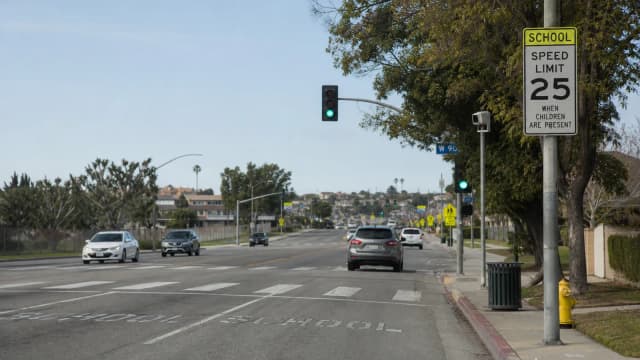
Speed cameras can be fixed at a single location, placed temporarily in a work zone, or mounted in a marked or unmarked vehicle, depending on state law. They are often used where conventional traffic stops are difficult or risky, such as school zones, high-crash corridors, construction zones and roads with limited shoulders.
The threshold for a ticket varies. Some programs issue warnings during a start-up period, some ticket only above a set number of mph over the limit, and some use different rules for school hours, work zones or residential streets. The posted speed limit still matters. A camera threshold is an enforcement policy, not permission to drive faster than the limit.
- Fixed roadside speed cameras
- Mobile camera vans or trailers
- Work zone speed systems
- School zone speed systems
Red light cameras are different
Red light cameras are not mainly speed cameras. Their purpose is to document a vehicle entering an intersection after the light has turned red. A driver already in the intersection when the light changes, such as while waiting to turn left, is usually treated differently from a driver who enters after red. Local rules and the recorded evidence determine how the notice is handled.
A typical red light system captures the vehicle before or at the stop line and again in the intersection. Many systems also record the time since the signal turned red, and some record video. Right turns on red can also be enforced in some places if the driver fails to make a complete stop or turns where right on red is prohibited.
Signal timing is a safety issue, not just an enforcement issue. Transportation agencies are expected to use proper yellow intervals and intersection design practices. Camera enforcement works best as one part of a broader intersection safety program, along with signal timing, visibility, crosswalk design, signs and police enforcement.
- Intersection-based enforcement
- Triggered during the red phase
- Evidence review before a ticket
- Rules for right turns vary
Tickets, fines, points and insurance
A photo enforcement notice is usually mailed to the registered owner of the vehicle, but the legal effect depends on the state and the authorizing local ordinance. In many places, camera tickets are civil penalties, similar to parking tickets, and do not add driver license points. In a few states or programs, a camera citation may be treated more like a traditional moving violation.
The amount due also varies widely. A city may set a flat civil penalty, a state may cap the fine, or a work zone program may use higher penalties for repeat violations. Some notices include administrative fees, late fees or instructions for a hearing. Do not assume that a red light camera ticket and a speed camera ticket have the same consequences, even in the same state.
Insurance effects also vary. Some state laws keep camera citations off the driving record or prevent insurers from using them for rates. Elsewhere, a moving violation may carry more serious consequences. The practical step is to read the notice carefully, confirm the vehicle and location, check the response deadline and use the official contest or payment process if you need to respond.
- Read the notice and deadline
- Confirm the plate, location and time
- Look for civil or moving violation language
- Keep copies of any response
Where cameras are used in the United States
The United States has no uniform national camera map or single national photo ticket rule. State legislatures decide whether speed or red light cameras are allowed, prohibited, limited to certain zones, or left to local authority. Even where state law allows cameras, a city or county may choose not to operate them.
As of May 2026, national legislative tracking reported speed cameras operating in hundreds of U.S. communities across 26 states and Washington, D.C. Red light cameras were also operating in hundreds of communities across 22 states and Washington, D.C. Several states prohibited red light cameras, speed cameras or both, while others allowed cameras only in limited settings such as work zones or school zones.
Because these laws change, drivers should avoid relying on old assumptions. A state that banned one type of camera may still allow another type, and a city may end a program when a contract expires. Conversely, new pilot programs can begin after a state law changes. The most reliable information for a specific ticket is the notice itself and the public agency named on it.
- Rules vary by state
- Programs vary by city or county
- Work zone and school zone rules may be separate
- Local notices control the specific case
What drivers should do near camera-enforced roads
The safest approach is simple: obey the posted speed limit, stop before the stop line on red, and drive at a speed suitable for traffic, weather and road conditions. Cameras are meant to change behavior before a crash happens, not just to issue fines after a violation.
Do not brake suddenly just because you see a camera. Hard braking can create a rear-end crash risk, especially on multi-lane roads or near intersections. Ease off the accelerator early, keep a safe following distance and prepare for signals, pedestrians, cyclists and work crews ahead.
Technology can help with planning, but it is not a substitute for attention. If you use the Speed Camera Radar Detector app, set up route and camera alerts before you start driving and leave the phone alone while the vehicle is moving. Camera databases can change, temporary mobile enforcement may not always be known in advance, and the legal duty to drive safely remains with the driver.
- Plan before driving
- Watch posted limits and signals
- Avoid sudden braking
- Never handle a phone while driving
A simple pre-drive checklist
- Set the route and alerts before moving.
- Check the first posted limit after every major turn.
- Leave enough space to adjust without abrupt braking.
- Use official sources when a rule affects your licence.